
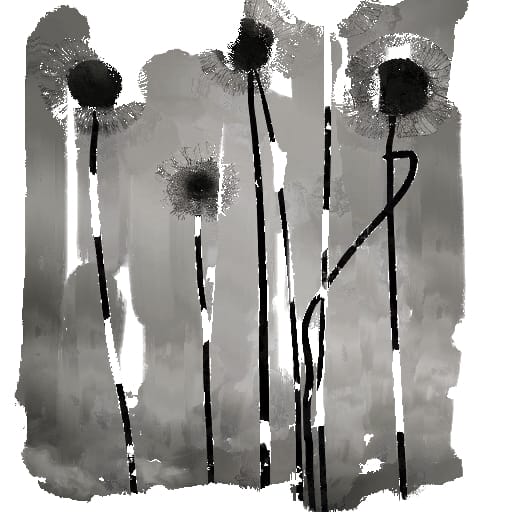
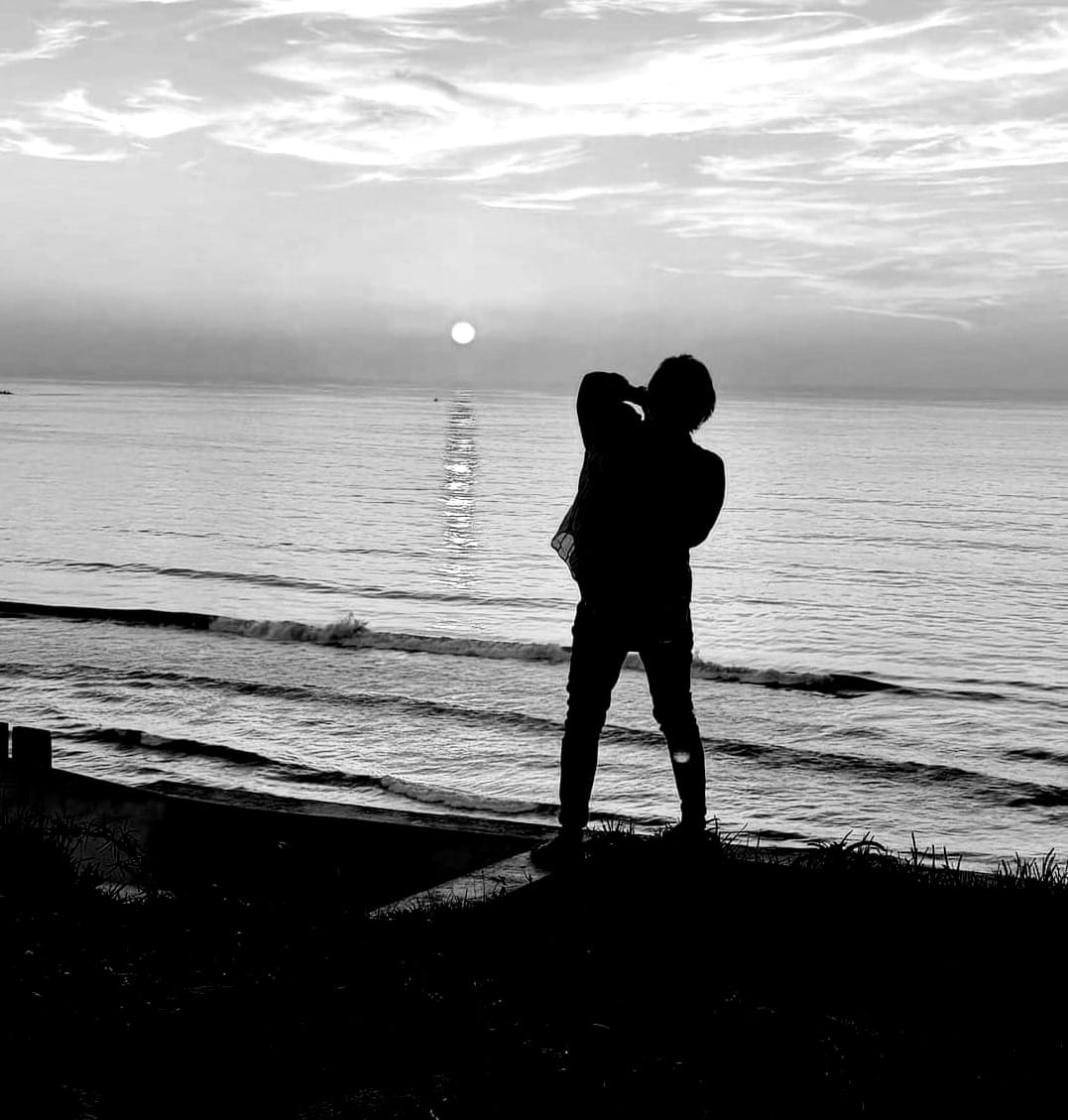
Chinese calligraphy has a delightful concept called feibai—"flying white". It relates to calligraphy and, on the face of it, it could be viewed as a mistake – it describes what happens when the brush travels quickly, the ink runs dry, and the gleam of the white substrate breaks through. The intended character is still very much recognisable, but flashes of white give it a new energy.
Rather than treating it as a fault, they have prized it for nearly two thousand years. Legend has it that Han dynasty scholar Cai Yong, came across some workmen dragging whitewash brooms across a wall and was captivated by the way the bristles left the surface showing through. It sounds a bit too neat to be entirely true, but let's give it the benefit of the doubt.
The energy of the white is not an artistic addition as such. Instead, it is the substrate - the paper - announcing itself. The white texture is breaking through the ink - the ground rising up into the figure, if you like. And it is also a record of speed. Centuries later you can still read how fast the arm was moving, because only a quick brush leaves the paper showing. The stroke carries the memory of its own making. Were the calligrapher to slow down in order to fill in the gaps, it would destroy the very thing that makes it alive, which is presumably why nobody does. A calligraphic stroke is the decisive mark. One pass, no corrections. Whatever happened in that half of a second is what the mark is destined to be.
I'm going to repeat that thought - slow down to fill in the gaps, and you would destroy the very thing that makes it alive. That seems to me to be worthy of consideration. I speak here as someone who tinkers and fiddles, dots the i's, crosses the t's and then wonders where the soul of the image has gone. I have spoken often about my love of contradictions. And here we have a very obvious one - the collision of the solid line and the broken line. Where the ink does and does not meet the paper, we have presence and absence, created from one gesture.
Of course I find myself wondering if there is a connection between this and the way we use our cameras. We talk about painting with the camera, likening the ICM sweep to a brushstroke. We usually assume that the movement should be even, one speed from edge to edge. But a gesture made at one steady speed is like a stroke with perfectly even ink. Neat and dutiful. But - if I can twist Leonard Cohen's observation about cracks and light - what if it is the case that the life gets in where the coverage fails?

In the camera we can vary the speed of our movement. Slow enough at the start so that the subject can materialise, then a sudden acceleration that rips streaks of light through the details already laid down. Or the reverse, a fast flick that slowly grinds to a halt. In calligraphy, the white shines through because the ground is always there, obediently waiting under the ink. In a photograph, I guess the equivalent might be light. The glitter on water behind dark reeds. The low sun in a hedge.
Standing in front of the ocean, I ask myself how it might work. Pretty hopeless on a day like today when the sky is blue, and the sea is bright. But we have days where the dark, heavy clouds predominate and just a chink of light gets through. That could be the 'ink' that streaks across the dark clouds. I could try metering for the shadows and really let the bright gaps flare. We are taught to observe our histograms and protect our highlights. But there are many times a burnt-out streak is not a calamity but in fact the whole point. Or I could do what I usually do – meter for the chink of light and have it zoom across the indigo clouds.
Perhaps more pertinent is the idea of the decisive mark. By definition, it means no retouching. We would need to treat exposure as final. Each image in a sequence remains and provides the history of the image. Similarly, no healing brush, no fixing it post. I'm not sure I can live without Cmd+Z
Nearly two thousand years ago, Chinese calligraphers recognised that a broken mark can be more alive than a perfect one. Whether any of these ideas expressed here survive contact with a dark cloud and a squiggle of Portuguese sunlight, I genuinely don't know. Perhaps I cannot distort them in a way that is relevant to photography; however, as I start to unpack my rollers and inks, I know they are very pertinent in the printmaking studio and the unforgiving irreversibility of a press. But that is another essay waiting to be written.

Taking the thought one step further with custom brushes and Rebelle and a photo of some daisies.