

I've spent far more time than is probably healthy trying to understand what a large language model actually is. Not how to use it – that part is easy enough – but what sort of thing it is.
I will happily admit I wouldn't be without it. In recent months, it has helped me decipher lengthy legal documents, understand Portuguese tax laws, negotiate my way through a largely incomprehensible tax portal, push back in reasonably fluent Portuguese on a pitifully inadequate insurance offer, and handle dozens of other daily tasks seemingly without complaint.
In much the same way that I threw myself into learning everything I could about computers in the mid-90s, I wanted to understand how these systems worked and how to get the best from them. The more I read, however, the more my curiosity drifted away from the technology itself and towards the questions it raises. Not technical questions, but ethical ones. I'll leave aside their environmental cost; that's a different, though no less important, conversation.
Many of us subscribe to regular blogs – Substack, Medium, etc. The more I learn about AI, the more I recognise its telltale signs are everywhere. And it goes far beyond the wretched em-dash. The worst offenders are the written equivalent of the early AI-generated images with their polished rhythm. Compliant and depersonalised.
Leaving aside for the moment the thorny issue of transparency and disclosure, what difference does it make to a reader if content was generated? Does it, for example, depend on context? Does it matter less if the piece is presenting information than it does if it is offered as, say, creative writing? Or storytelling? What about poetry and music?
Nobel Prize winner Olga Tokarczuk landed in hot water recently. At Impact'26, she spoke about investing in the highest, most advanced language model available and how it shocked her by the way it broadened and deepened her creative thinking. She described how she talks to it. 'Darling, how could we develop this beautifully?' She then went on to say how much her heart ached for literature written over months in solitude by one conscious mind, but that economically, the time taken meant it was no longer viable.
However, what her audience heard was an admission from a Nobel Prize winner that her upcoming novel was written with the help of AI. The backlash that followed was predictable. She issued a statement through her publisher saying that remarks made in front of a live audience can be misinterpreted, that she had written the book without assistance, and that she uses AI only for preliminary research.
When Berlin-based photographer Boris Eldagsen won the creative open category in the prestigious Sony World Photography Awards, he refused the prize on the grounds that his AI-generated imagery should not compete on the same stage as images made with a camera. In a statement published on his website, Eldagsen said that he applied to the competition "as a cheeky monkey" to find out if such events are prepared for AI images to be entered. The problem arose only when he disclosed the truth about the way the image was made.
So is it a question of transparency?
Let's look at Richard Prince, possibly best known for his unapologetic appropriation of mass media imagery. His imaginative spin dressed it up as appropriation art, using conceptual critique to pass his 'borrowing' off as high-value cultural commentary.
Full disclosure settled nothing for him. In January 2024, on the eve of trial, Prince agreed to pay Donald Graham (Rastafarian Smoking a Joint) and Eric McNatt (portrait of musician Kim Gordon) $650,000 in damages plus $250,000 in costs, the damages calculated at five times what he had sold the works for. No admission of infringement. No ruling on fair use. The question everyone had waited eight years for remained unanswered.
The Solomon R. Guggenheim Museum frames Richard Prince's "stolen" Cowboys thus: "In his Cowboys works, Prince appropriated images of the Marlboro Man, highlighting the imagined Western lifestyle being sold in cigarette ads." Ah – of course.
So 'you deceived me' became 'you took something you didn't create, and you monetised it in a way that the original creator of the work did not'. And I find myself wondering how much – if at all – this aligns with the AI argument, given all the training data. Unless, of course, we can distinguish Prince from an LLM on the grounds of intent or irony (in doing so we obviously need to dismiss the persistent stereotype that Americans don't do irony).
I'm not sure what that lengthy preamble is trying to prove. My thinking remains woolly at best. Leaving aside the many creative dilemmas, it could be argued I am cheating professionals by getting Claude to do legal and accountancy work that I would once have paid them to do. Yet I use it daily without a thought.
Substack has recently announced a partnership with an AI detector tool that boasts 99% accuracy and is trained very differently from the usual flaky AI detectors. Of course, curiosity immediately got the better of me, and my next move was to run a selection of my essays through said checker. All my old essays came back 100% human-written. The ones where I had had help came back flagged in varying percentages. I was horrified as I thought I had comprehensively rewritten the ideas offered up by ChatGPT. In fact, it seems all I had done was a bit of light scrubbing. Repositioned a few adjectives. I have since reformatted the offenders with my own clumsy arrangement of words. Rightly or wrongly, it matters to me.
Which brings me to this. What difference does it make to a reader if a paragraph was generated? I want to say none at all, if it is good; if it makes me think or laugh or cry or whatever. And yet I don't really think I believe that. The moment I start thinking about authorship, originality and borrowing, my certainty evaporates. I know I'd object to someone passing off another writer's work as their own, so why is this different? Or perhaps it isn't?
In May 2026, conceptual artist SHL0MS tricked millions of social media users into ruthlessly dissecting a genuine 1915 Claude Monet Water Lilies painting by presenting it as AI-generated, using the platform's own "Made with AI" label. Many critics deleted their comments following the reveal but not in time to prevent many screenshots being taken.
What difference does the label make to a reader? Clearly quite an important one, and yet not a reliable one, since 6.7 million people looked at a real Monet and a significant number confidently listed all the telltale AI giveaways.
Which leads me to ... why does it bother me when AI writes a paragraph, yet not bother me when it helps me think? Does it matter less for research than it does for, say, critical thinking? Creative thinking? Reflective thinking?
There is no conclusion here. This essay dribbles away into uncertainty and confusion as usual. Surely that must prove there's a human sitting here, spilling tea and tapping away at the keyboard? Yes, I have run it through my LLM and it helped me sharpen a couple of the arguments. Thankfully, the sniffer dogs still flag it as 100% written by a human. Warts and all. So that's alright. Or is it?
For what it's worth, everything I publish here is written by hand. If I ever lean on the machine more than lightly, I'll say so at the top. I will happily continue to use it to expand ideas and make connections; I did so in my David Hockney/Duane Michals piece, and it gave me links I could never have found. It has helped me shape my thinking for this piece.
I'm probably never going to call it Darling.
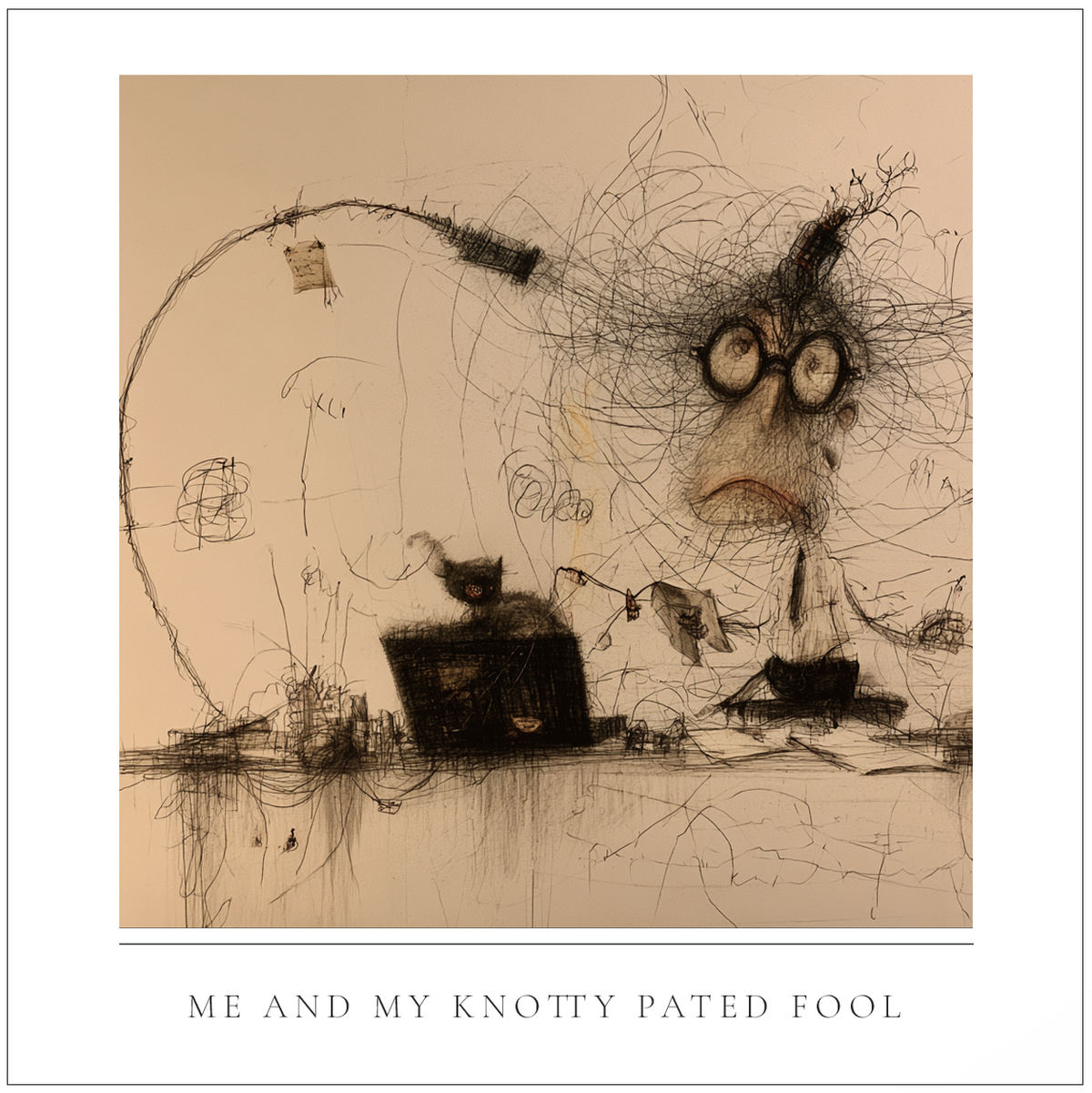
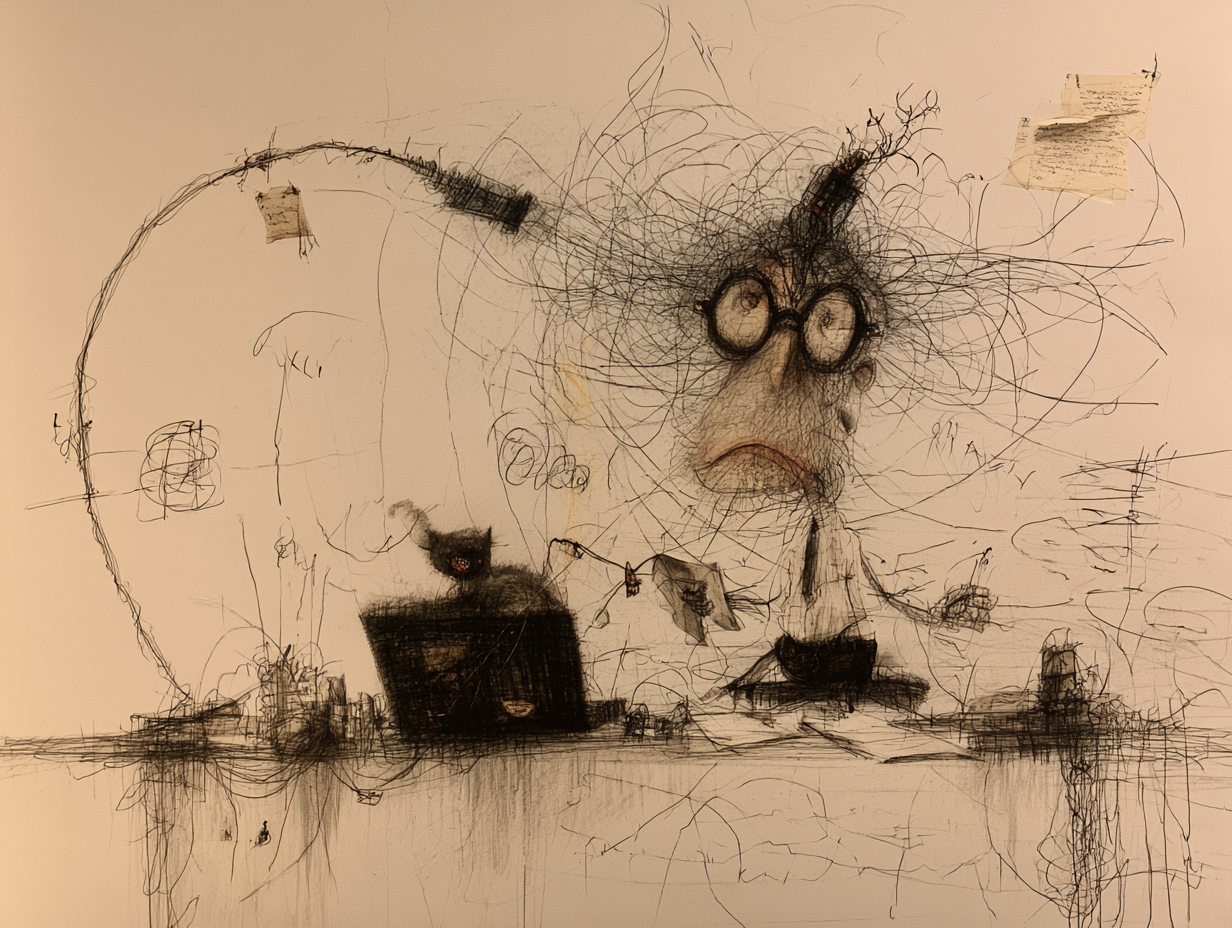
We've got more of a 'good morning, you knotty-pated fool; help me untangle this' kinda vibe going on. That works better for me. Keeping it real… Oh, the irony.
prompt: /depict my LLM as a knotty pated fool